Who Should Prevent Smoking?
 A Report by Elise Barrus
Smoking has become an issue for both smokers and non-smokers alike. Both parties are experiencing the effect of smoking in some way or another. The addiction to nicotine has made it hard for smokers to quit, and non-smokers have died from second-hand smoke. Thousands of teens experiment with smoking each day, only to find that the risk of addiction was greater than they had anticipated. This report states the facts and dangers of smoking and raises these questions: Who is responsible to help people quit this habit? Who is responsible for keeping this habit away from minors?
Suzy Lochridge has just come out of surgery to remove a lung tumor, a result of years of cigarette smoking. When she wakes up, her first words are, “Can I have a cigarette?” (Mollenkamp, Levy et al. 3).
The Problem
What happens when a person tries to quit smoking? According to a paper by scientists, produced for the British American Tobacco Company,
“A body left in this unbalanced state craves for renewed drug intake in order to restore the physiological equilibrium. This unconscious desire explains the addiction of the individual to nicotine” (Kessler, 60).
As a result of this addiction to nicotine, more than 440,000 Americans die each year. These deaths are caused from smoking related illnesses such as lung cancer and heart disease (CDC).
Around 4 million minors smoked cigarettes in 2010 (Belnora). If fewer teens started smoking, America would be a lot healthier, as adults are a lot less likely to pick up the habit than teens. A staggering 80% of smokers today started smoking before their 18th birthday (CDC). A large number of adolescents think that they can quit at any time. Only 5% of high school seniors that smoke think they’ll still be smoking in five years, but actually 75% of them end up keeping the habit (Romero, E1). Since most teens think that they can quit at any time, most don’t worry about the health risks or the addiction factor, but that doesn’t necessarily mean that they aren’t aware of them. Advertising of the health risks of smoking can be found in many places in America but many teens still think they are strong enough to handle smoking, or that they will consider the health risks later on. A 17-year-old high school student said,
“I’m addicted, but I’m strong....I got strong lungs.” (E1). 
Why is Smoking So Bad?
Smoking has been linked to emphysema, lung cancer, cancer of the larynx, and heart disease. Emphysema damages the lungs and makes it difficult for the person with the condition to breath. Some people who have smoked for several years often need to use a machine to help them get enough oxygen. On the other hand, some people who smoke for several years never even get cancer and never need to use an oxygen machine. Some lifelong smokers die from old age. However, the risk of getting cancer from smoking is fairly high. Smokers are 10 to 20 times more likely to develop, or die from, lung cancer than are non-smokers (CDC).
Why Do Teens Start Smoking?
Some believe that the tobacco industries’ business practices may not be to blame for death caused by smoking. The reasons teens start smoking are varied.
The American Lung Association cites these top five reasons:
Their parents are smokers.
- Peer pressure – their friends encourage them to try cigarettes, and to keep smoking.
- They see smoking as a way of rebelling and showing independence.
- They think that everyone else is smoking, and that they should, too.
- Tobacco advertising targets teenagers
Who’s To Blame?
Many people think that if we can figure out what is causing people, especially teens, to smoke then we will be able to move forward with better prevention methods, while others believe that we have done enough to prevent smoking.
The Tobacco Company & Business Ethics
In the 1950’s Philip Morris was in need of an icon. The company’s new Marlboro brand hadn’t taken hold and health concerns were shifting smokers toward filtered cigarettes. Philip Morris didn’t currently have a filtered cigarette, so the company decided to turn the Marlboro campaign around and approach it with a completely new angle. The Marlboro brand was currently bringing in the lowest number of sales for the company and Philip Morris had the difficult task of making a filtered cigarette appealing to men. The company hired advertising legend Leo Burnett and his company to come up with an advertising icon for Marlboro. This team came up with the most masculine symbol it could think of, the cowboy (Schalch).
Advertising Success
- The Marlboro Man became a national icon in 1955 and increased the Marlboro brand’s sales by 3,241% within one year, putting the sales at $5 billion (Enrico).
- In 1921, RJ Reynolds started advertising the, “I’d Walk a Mile for a Camel” slogan. By 1923, a mere two years later, RJ Reynolds had 23% of cigarette sales in the country (Mollenkamp, Levy et al. 249).
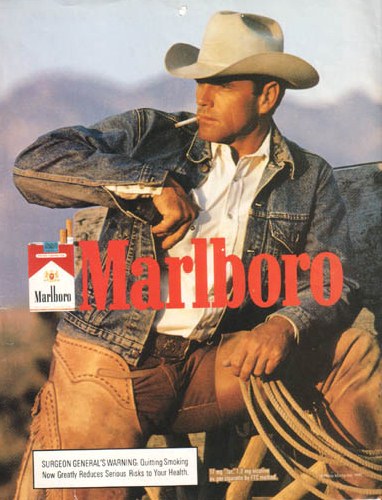
Many have blamed the tobacco industries for their business practices throughout the years. The tobacco industry has been blamed for targeting teens with their ads, and they have been blamed for deceiving the public into thinking tobacco is harmless.
It seemed that all of this denial and inappropriate use of advertising (inappropriate according to some) was paying off for the tobacco companies. Joe Tye, an executive officer at Stop Teen-Age Addiction to Tobbaco” said,
“[Teenagers] most often smoke the three most advertised brands – Marlboro, Camel and Newport” (Romero, E1).
Also, a study done at the University of Michigan found that the Marlboro brand accounted for 60 percent of teen smokers (Johnston, O’Malley et al. 7).
Advertising has almost been banned completely in an attempt to decrease the number of smokers, but some still blame advertising for starting a trend in smoking that is still happening today, Others claim, however, that the tobacco companies should have the same rights as any other company, and that people have a choice as to whether or not they will be affected by their tactics.
Parent Responsibility
The National Survey on Drug Use and Health revealed that teenagers who live with mothers that smoke and/or mothers that have had a major depressive episode (MDE) in the last year are three times more likely to light up than those who don’t live among these conditions (1).
Some think that the guilt that others put on parents is wrong. One smoker said,
“Today, the primary tactic is to heap guilt on smoking parents making them out to be the villain who doesn’t care for their children” (Smoke Signals).
Tobacco Free Center claims that the tobacco industry’s youth preventative programs focus on placing the blame on parents, and on making themselves look better, instead of taking responsibility for a product that kills hundreds of thousands each year (3).
Another problem that people see in blaming a parent who smokes is that, according to them, the tobacco companies are responsible for getting the parent addicted in the first place.
While Philip Morris may have initially claimed that cigarettes were no more addicting than Gummy Bears (Mollenkamp, Levy et al. 14), today, the people at Philip Morris are saying something else. On the company’s website, there is a statement warning consumers that “it can be very difficult to quit smoking” (Philip Morris USA). The fact that nicotine is addictive is rarely disputed today, but the question of whether or not people have a choice to overcome it is. William F. Buckley, a late journalist, argued that, “addiction cannot be dismissed as free choice” (Jha, 80).
People argue that minors and even some adults cannot comprehend the consequences of starting to smoke. Still, others cite the millions of people that don’t smoke as proof that people have the power to make healthy decisions. In addressing the power of advertising, Jacob Sullum commented,
“We clearly are not helpless to resist the persuasive powers of Philip Morris, et al. – all of us see the ads, but only some of us smoke” (186).
Peer and Social Pressure
Spencer Wolf, a 17-year-old smoker said,
“Smoking is cool. I saw everyone else smoking and that’s when I started smoking a pack a day. I won’t stop. Others won’t either. There’s no advertisements for drugs and no Joe Camel for drugs, and a lot of people do drugs” (Mollenkamp, Levy et al., 11).
Some think that society is to blame for the number of smokers in America. People blame celebrities and the media for showcasing smoking as a rebellious and often sexy activity. It is true that many movies and media portray beautiful and young people smoking as a socially accepted activity, and even show minors smoking to rebel. However, some are reluctant to blame the media and society because, for them, it goes back to personal choice and the industries’ right to free speech.
Conclusion
Many people, smokers and non-smokers alike, find smoking to be problematic. Around 70% of today’s smokers say they wish they could quit (CDC). The question is, should tobacco companies be regulated even more than they are today or should they have the same freedoms as any other company? Where does the responsibility to quit or to prevent smoking lie – with the government or with ourselves?
Works Cited
Adolescent Smoking and Maternal Risk Factors. Department of Health and Human Resources, 7 May 2010. Web. 21 June 2011. Path: samhsa.gov.
American Lung Association. Convio, n.d. Web. 22 June 2011. Path: lungusa.org.
Belnora, Lucy. The Kansas Free Press. N.p., 4 June 2010. Web. 7 July 2011. Path: kansasfreepress.com.
Centers For Disease Control and Prevention. OADC, n.d. Web. 23 June 2011. Path: cdc.gov.
Enrico, Dottie. Advertising Age. Crain Communications, 29 Mar. 1999. Web. 21 June 2011. Path: adage.com.
Jha, Prabhat. Death and Tobacco Taxes. Ed. Susan Hunnicutt and Elizabeth Des Chenes. Farmington Hills: Greenhaven Press, 2009. 80. Print.
Johnston, O'Malley, et al. Monitoring the Future. The Regents of the University of Michigan, 1999. Web. 21 June 2011. Path: monitoringthefuture.org.
Kessler, David. Statement on the Control and Manipulation of Nicotine in Cigarettes. Ed. Carol Wekesser. San Diego: Greenhaven Press, 1997. 66. Print.
Mollenkamp, Levy, et al. The People VS. Big Tobacco. Princeton: Bloomberg Press, 1998. 3. Print.
Philip Morris USA. Altria Group, n.d. Web. 19 June 2011. Path: philipmorrosusa.com.
Romero, James. "The First Puff." LA Times 18 Sept. 1996: E1. Sirs Researcher. Web. 23 June 2011.
Schalch, Kathleen. "The Marlboro Man." National Public Radio. PBS, 21 Oct. 2002. Web. 23 June 2011. Path: npr.org.
Smoke Signals. Data Synthesis, 14 Apr. 2007. Web. 23 June 2011. Path: jeremiahproject.com.
Sullum, Jacob. Cowboys, Camels, and Kids: Does Advertising Turn People Into Smokers? Ed. Susan Hunnicutt and Elizabeth Des Chenes. Farmington Hills: Greenhaven Press, 2009. 186. Print.
“Tobacco Advertising, Promotion and Sponsorship”. Campaign For Tobacco Free Kids. N.p., Nov. 2008. Web. 23 June 2011. Path: tobaccofreecenter.org.

